Physicochemical and Polyphenolic Properties as well as the Health Prospects of Adansonia digitata Seeds and Pulp
Pages 228-244
https://doi.org/10.48309/IJABBR.2025.2042326.1545
Isaac Kwabena Asare, Bernard Tawiah Odai, Leticia Amoakoah Twum, Hayford Ofori, Benjamin G. Fosu, Martin Adarkwah-Yiadom, Bernard Darfour
Abstract Background: The baobab tree (Adansonia digitata L.) is a versatile tree, with edible fruits, seeds, leaves, and flowers. This study evaluated the physicochemical and polyphenolic properties, and health prospects of the seeds and pulp of Adansonia digitata L.
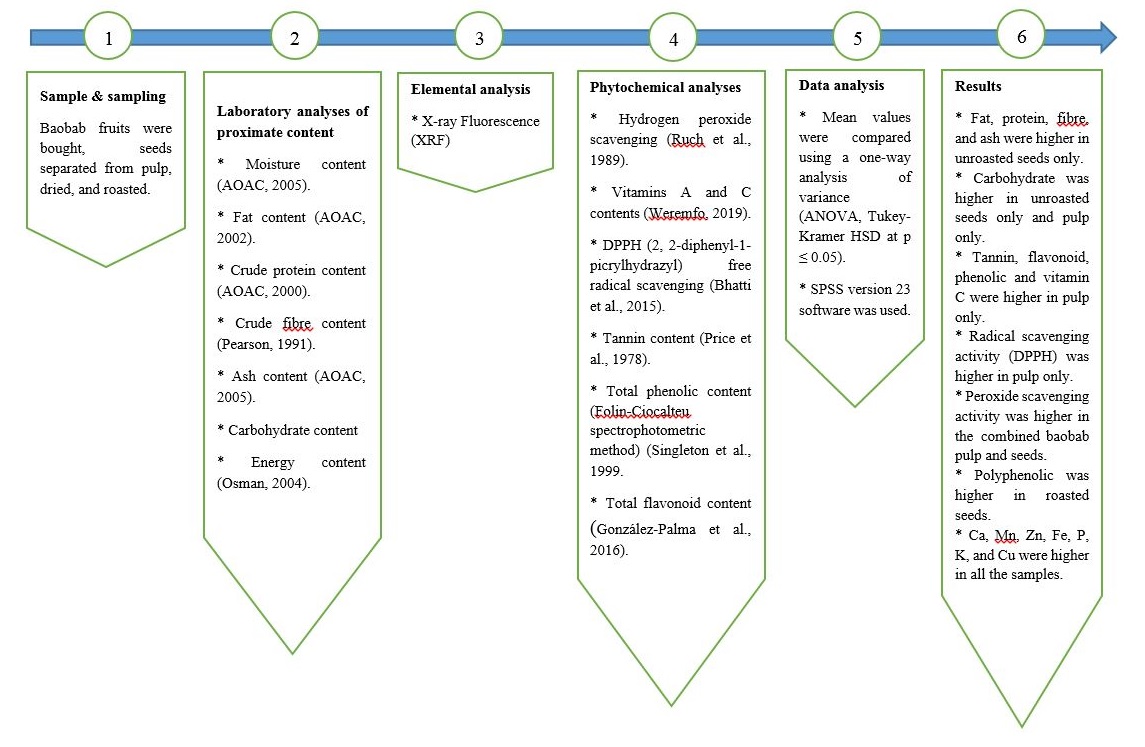
Materials and methods: The fruits of baobab were bought from a market in Tamale, Ghana. The fruits were processed to isolate the seeds from pulp. The portions used were the baobab pulp only (BPP), unroasted baobab seeds only (BSD), roasted baobab seeds only (RBSD), and baobab seeds and pulp combined (BPSD).
Results: The results from the fat content, protein content, crude fibre, and ash content showed that unroasted baobab seeds only (BSD) were higher compared to the baobab pulp only (BPP), roasted baobab seeds (RBSD), and baobab seeds and pulp combined (BPSD). The highest carbohydrate content of 73.02% was recorded for BSD and BPP. BPP had the highest tannin content of 18.44 mg/g, total flavonoid (2.05 mg/g), total phenolics (14.48 mg/g), and Vitamin C (5.37 g/100 g). BPP had a higher radical scavenging activity (DPPH) while BPSD had a higher peroxide scavenging activity. RBSD had the highest polyphenolic content more than the rest of the samples analyzed. All the samples had Ca, Mn, Zn, Fe, P, K, and Cu.
Conclusion: The baobab seeds and pulp contain antioxidants and, hence, can be utilized as a functional food constituent and additive. The seeds (roasted/unroasted), pulp and seeds (combined/uncombined) manifested nutritional and health prospects, although seed roasting had an added advantage.